The Art of Evoking Tone Colors from a Flute
Updated: Mar 9
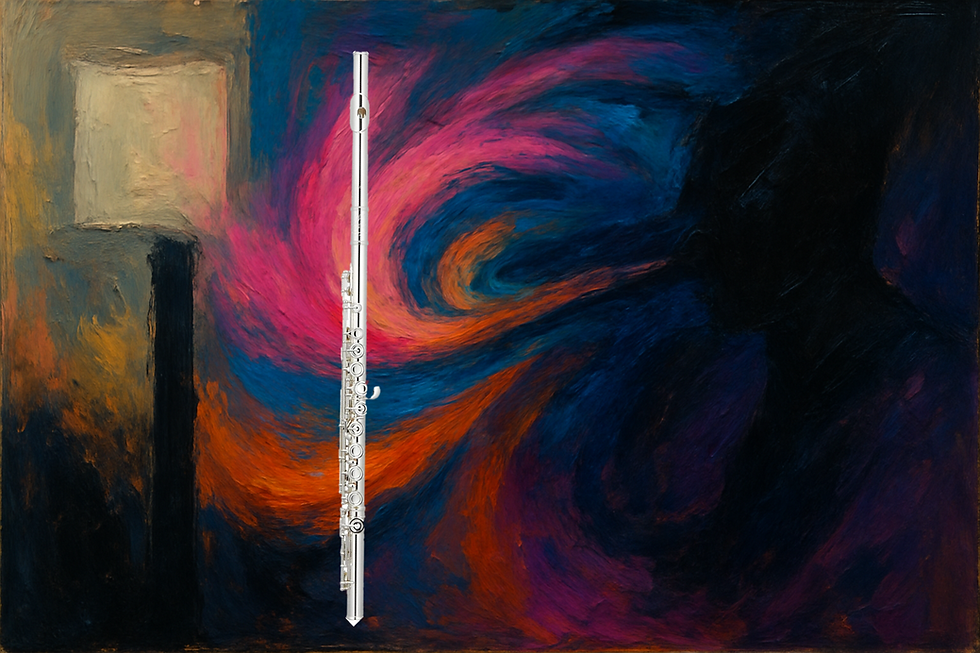
Tone colors are the soul of flute music and give life to mere notes on a page. The colors the written notes into a vivid painting of emotions in motion that captivates listeners. While technical precision is essential, the ability to evoke tone colors is what elevates a performance from competent to truly artistic. Achieving this requires mastery of several variables in unique combinations, including breath control, embouchure adjustments, air direction, the size of the air jet, and the openness of resonators such as the midsection, chest, sinuses, and nasal cavities. Importantly, all of these elements must be approached with gentle control, free from tension or stress, to ensure that tone colors are produced with ease and fluidity.
Variables for Evoking Tone Colors
1. Breath Control
Breath control is the foundation of tone production and tone color manipulation. It involves regulating the air pressure created by the diaphragm, lungs, and chest. For warm and resonant tone colors, such as "orange," the air pressure should be slightly more than pink, allowing for a steady airstream. Conversely, for cooler tone colors like "blue," or for the innocent pink, the air pressure can be decreased slightly, allowing the Bernoulli effect to create the resonance, and vibrato, or the absence thereof, to define the color.
Gentle control is key—overblowing or forcing the sound compromises the quality of the tone. Instead, flutists should aim for a natural and effortless flow of air, supported by the diaphragm and guided by mindfulness of their breathing. Lately I've been finding that less air is more quality, when it comes to tone color.
2. Embouchure Adjustments
The embouchure acts as the flutist's mouthpiece, shaping the airstream into a precise air jet. By adjusting the embouchure, flutists can craft a wide range of tone colors. For example:
A relaxed and rounded embouchure with low air pressure and no vibrato creates a "pink" tone, characterized by softness and intimacy.
A relaxed and rounded embouchure with low air pressure and fast, fearful vibrato creates a "blue" tone.
A relaxed but firmer and well-supported embouchure supporting more air pressure generates a "black" tone, full of intensity and drama.
The key to effective embouchure adjustments is flexibility, and flexibility in flutistry is rarely if ever forced. It's best to avoid rigid or static embouchures, as these can lead to tension and limit the range of tone colors. Instead, the embouchure should adapt naturally to the needs of the music, allowing for smooth transitions between colors.
3. Air Direction
Add to breath control (air pressure control) and flexibility of embouchre the direction of the air stream into or over the embouchure hole significantly influences tone color. For warmer tones, the air stream can be directed slightly downward into the flute, creating a fuller and more resonant sound. For cooler or more hollow tones, the air stream can be directed more across the embouchure hole, producing a focused and shimmering quality.
Experimenting with air direction allows flutists to discover subtle variations in tone color. For example, tilting the head slightly or adjusting the angle of the flute can change the trajectory of the air stream, opening up new possibilities for expression.
4. Size of the Air Jet
The size of the air jet is another critical variable for tone color production. A narrow and concentrated air jet creates a more focused tone and reduces potential impurities especially when paired with proper air pressure, while a wider and more diffuse air jet produces a mellow and expansive sound, but often with impurities when overblown. For example:
A narrow air jet contributes to a "blue" tone, with a cold and ethereal quality when paired with relatively less air pressure, and a fast vibrato, with air directed more across the embouchure hole.
A very slightly wider air jet can produce an "orange" tone when paired with slightly more air pressure, and directing the air more into the embouchure hole, enveloping the listener in warmth and richness.
Flutists can visualize the air jet as a "long straw" for focused tones or a "short straw" for diffuse tones. This mental imagery can help them adjust the size of the air jet with ease and precision. Another helpful practice is to allow the lips to form around the air as it comes out resulting from well controlled air pressure, letting the shape of the lips create the straw from the air itself, rather than trying to manipulate the muscles to create the tube to shape the air.
5. Openness of Resonators
The openness or closedness of resonators, such as the midsection, chest, sinuses, and nasal cavities, plays a significant role in shaping tone colors. For example:
A more open chest and midsection can enhance resonance and enhance the resonance of "pink" or "orange" tone, when combined with the requisiste air pressure, embouchure, and air direction, whether into or across the embouchure hole.
Slightly closing the sinuses and nasal cavities can remove resonance, which is called for as a contrast against passages where resonance should really stand out.
The combination of embouchure and nasal resonance) highlights the importance of using the sinuses and nasal cavities to enhance tone colors. By allowing a small amount of air to pass through the nasal passages, flutists can add a unique resonance to their sound, enriching the overall tone color palette. By closing those passages, the flutist can deaden the sound a bit, perhaps to bend better with another instrument, or to create contrasts.
The Importance of Gentle Control
All of these variables—breath control, embouchure adjustments, air direction, air jet size, and resonator openness—must be approached with gentle control. Tension or overexertion can lead to diffused tone quality, cracked notes, and even physical discomfort. Instead, flutists should aim for minimal use of muscles, relying on natural cooperation between the body and the instrument. That struggle has been a part of my flute journey for quite some time.
Relaxation, playing at ease - these are essential for progress. By focusing on the flow of air and the subtle movements of the embouchure, flutists can produce tone colors effortlessly, allowing the music to take over and guide their expression.
Conclusion
Evoking tone colors from the flute is both an art and a science, requiring mastery of breath control, embouchure adjustments, air direction, air jet size, and resonator openness. By approaching these variables with gentle control and mindfulness, flutists can unlock a vibrant palette of tone colors and bring their music to life.
Tone colors are not just technical tools—they are the emotional language of the flute, enabling players to connect with their audience on a deeper level. With practice, experimentation, and a focus on ease and fluidity, flutists can transform their playing into a soulful and expressive art form.


Comments